National Seminar Addresses the Impact of Higher Education on the Sustainable Development Goals
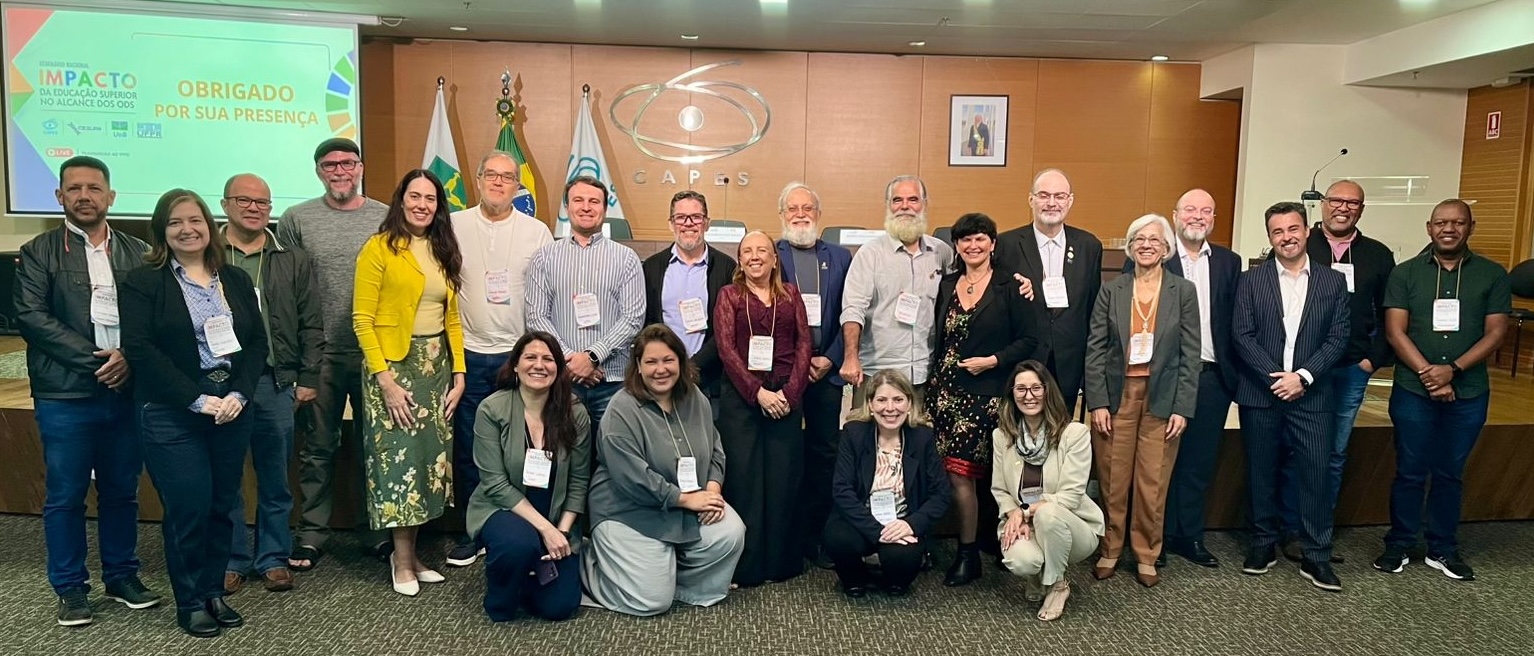
On June 23 and 24, 2026, CAPES hosted, in Brasília, the National Seminar on the Impact of Higher Education on Achieving the Sustainable Development Goals (SDGs). Under the coordination of Prof. Carlos Alberto Cioce Sampaio, Coordinator of the Environmental Sciences Area at CAPES, and held in hybrid format, the event brought together 1,070 registrants, 75 in-person participants, and recorded 1,600 views, demonstrating broad national reach.
The initiative was organized by the University Center of the State of Pará (CESUPA), the University of Brasília (UnB), and the Federal University of Paraná (UFPR), with support from CAPES. It was structured around dialogue panels composed of representatives from higher education institutions, funding agencies, CNPq, CONFAP, FOPROP, FORPROEX, IBICT, CNODS, and ANPG, as well as researchers and academic managers committed to the 2030 Agenda.
Conceived as a space for national dialogue and coordination, the Seminar focused on identifying, systematizing, and disseminating initiatives with significant impact — measurable or socially recognized — on the SDGs, encompassing the social, environmental, economic, and institutional dimensions of sustainable development, including the complementary SDGs proposed within the Brazilian context.
The program highlighted integrated experiences in teaching, research, innovation, and university outreach, reaffirming the strategic role of higher education and graduate studies in knowledge production, in the training of qualified human resources, and in building solutions to contemporary socio-environmental challenges. The debate on impact assessment, outcome indicators, and mechanisms for the visibility of academic contributions to society also held a central place in the agenda.
The event took place at a particularly relevant moment for the National Graduate Education System, marked by the growing recognition of science's impact on society and by the need to demonstrate, in objective terms, the contributions of higher education to the promotion of sustainable development. In this context, the Seminar reinforced the importance of integration among universities, funding agencies, the public sector, productive sectors, and civil society in the implementation of the 2030 Agenda.
For the Environmental Sciences community, the event represents an opportunity to reflect on the transformative capacity of interdisciplinary scientific production, social and technological innovation, and outreach actions oriented toward sustainability. Topics such as climate change, biodiversity, food security, sustainable cities, socio-environmental justice, education for sustainable development, and territorial governance reaffirm the centrality of the field in building responses to global and local challenges — and interdisciplinarity, a constitutive trait of Environmental Sciences, proves essential for understanding and addressing the complexity of these problems.
By fostering the exchange of experiences and the visibility of good practices, the National Seminar contributes to consolidating an agenda of cooperation and collective learning, strengthening the commitment of Brazilian higher education institutions to sustainability, social inclusion, and the construction of more just and resilient futures.
Text based on official information from the National Seminar on the Impact of Higher Education on Achieving the Sustainable Development Goals.